
Do Solar Fans Run at Night?
Jul 14, 2026
Most buyers have the same question: Can a solar fan still work at night without sunlight? The answer is straightforward: solar fans with built-in batteries can run continuously at night, while direct-powered models without batteries only operate during daylight and stop after sunset. This article explains the core logic behind nighttime operation, runtime performance, adaptability in cloudy weather, and others-helping you choose a solar fan that can run at night.
How Do Solar Fans Work at Night?
Whether a solar fan can operate at night depends on whether it is equipped with an energy storage battery and an intelligent power switching system. The working process includes two main stages: daytime energy storage and nighttime discharge.
Daytime Charging (Energy Storage Phase):
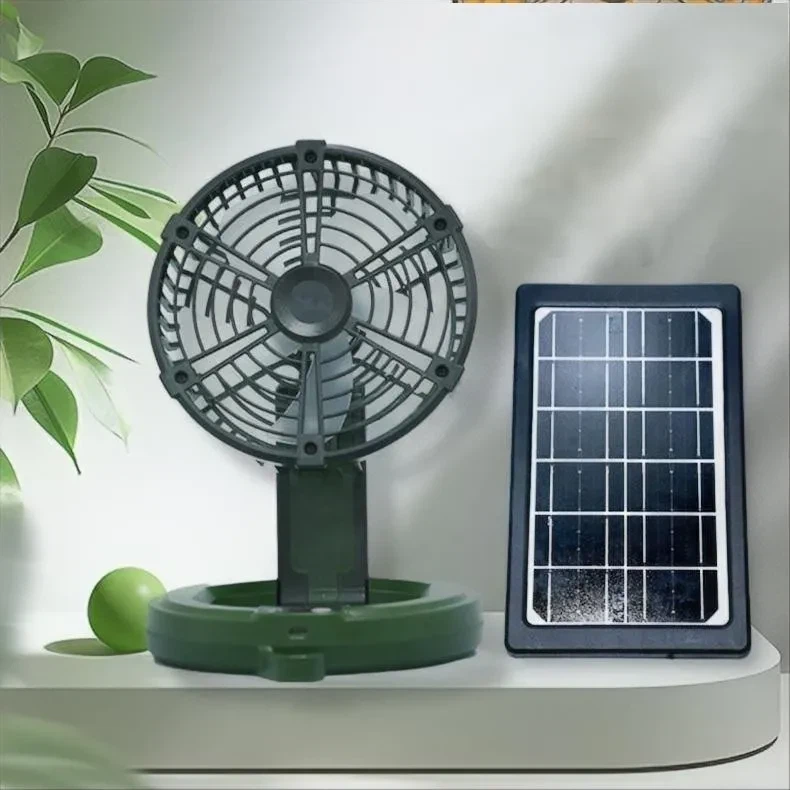
The solar panel (monocrystalline or polycrystalline) absorbs sunlight and converts it into DC power through an integrated MPPT charge controller. Part of the energy directly powers the fan, while the excess is stored in a high-capacity lithium battery. With an IP67 waterproof solar panel and adjustable mounting bracket, the system maximizes sunlight capture. Typically, 6–8 hours of strong sunlight is enough for a full charge.
Automatic Nighttime Operation (Discharge Phase):
As sunlight weakens or disappears at dusk, the intelligent controller automatically switches from solar input to battery mode. The stored energy powers a brushless motor to provide continuous airflow throughout the night-no manual switching required, and no shutdown after sunset.
Dual Charging Backup
Many solar fans support dual charging: solar + USB/grid power. During extended cloudy or rainy periods, users can recharge the battery via an external power source to ensure uninterrupted nighttime operation. This effectively solves the limitations of purely solar-powered systems.
In contrast, direct-powered solar fans without batteries have no energy storage. They only run under direct sunlight and provide no airflow at night, making them suitable only for short daytime ventilation (e.g., greenhouses or warehouses), but not for home use or overnight camping.
How Long Can a Solar Fan Run at Night?
Nighttime runtime depends on four key factors: battery capacity, fan power, speed settings, and solar charging efficiency. Based on tested data from Yahua production models:
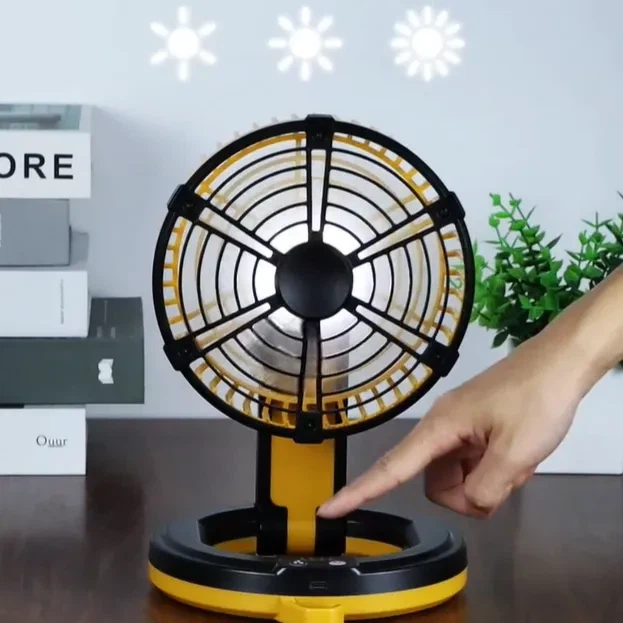
1.Mini Portable Camping Solar Fans (5W–7W, 5000–10400mAh battery): Low speed: 20–30 hours, medium speed: 10–15 hours, high speed: 5–8 hours, many models include an integrated mosquito-repellent LED light, combining cooling and lighting-ideal for overnight use in tents.
2.Household Split Solar Fans (10W solar panel, 12000–20000mAh battery): With three speed levels, these fans can run 8–14 hours overnight at medium speed after a full charge. Suitable for bedrooms, balconies, and RVs. Remote control and timer functions help save energy.
3.High-Power Ventilation Fans for Farms (20W–30W panels, large external batteries): At low-speed circulation, these systems can run 12–24 hours continuously. With temperature sensors, they automatically maintain airflow at night, preventing heat buildup and oxygen deficiency for plants and livestock.
Can Solar Fans Work on Cloudy or Rainy Days?
Solar fans can still charge and operate on cloudy or rainy days, but their power output and charging efficiency will drop significantly. Performance varies depending on the product type:
1.Solar Fans with Built-in Battery (Recommended)
Even under cloudy conditions, diffused sunlight can still generate electricity through the solar panel, although output is typically only 15%–30% of that on sunny days, resulting in much slower charging. Short periods of cloudy weather usually do not affect nighttime operation. However, during continuous rain or overcast conditions lasting more than three days, solar energy alone may not fully charge the battery. In such cases, it is recommended to use USB or grid power backup charging to ensure uninterrupted nighttime use.
2.Direct-Powered Solar Fans (No Battery)
On cloudy days, airflow becomes weak due to insufficient power generation, and during heavy rain, the fan may stop almost completely. Since these models have no energy storage, they cannot operate at night at all. They are only suitable for daytime ventilation in environments with stable sunlight, such as open factories or warehouses.
For regions with frequent rain or fog, it is strongly recommended to choose solar fans with dual charging options and large-capacity batteries, ensuring reliable charging in low-light conditions and continuous operation throughout the night.

What Factors Should You Consider When Buying a Solar Fan?
To ensure stable nighttime operation and long service life, overseas buyers and end users should focus on the following six key parameters:
1. Battery Type and Capacity
Prioritize LiFePO4 (lithium iron phosphate) batteries, which offer 2,000–3,000 charge cycles, compared to 500–1,000 cycles for standard lithium-ion batteries. Avoid low-cost lead-acid batteries, as they suffer from rapid capacity loss in low temperatures and unstable nighttime performance. Capacity selection by application can be: Camping: 8,000–12,000mAh. Home use: 15,000mAh+. Farm/ventilation: 20,000mAh+
2. Solar Panel Power and Material
Monocrystalline panels (20%–22% efficiency) outperform polycrystalline panels, especially in low-light conditions. For outdoor use, choose IP67 waterproof panels for durability against rain and sun exposure. Minimum for household use: 10W/ Greenhouses/large systems: 25W+
3. Waterproof Rating
For outdoor, agricultural, or rainy environments, select models with IP67 full-unit protection and corrosion-resistant aluminum fan blades to prevent water damage and ensure reliable nighttime operation.
4. Motor Type
Brushless DC motors are recommended due to lower noise, higher efficiency, and longer lifespan (up to 20,000 hours). They can improve nighttime runtime by around 30% compared to brushed motors, which are noisier and consume more power.

5. Additional Features
Features such as remote control, multiple speed settings, timer functions, mosquito-repellent LED lights, USB output, and dual charging (solar + grid/USB) significantly improve usability, especially at night.
6. Installation and Application Fit
Portable hanging models: ideal for camping. Wall-mounted or floor-standing: suitable for home use. Fixed high-power exhaust fans: designed for greenhouses and farms. Choosing the right installation type ensures optimal performance in each scenario.
5. Recommended Configurations for Common Scenarios
If you need a solar fan to run for a specific number of hours at night, use the following formula to estimate the required battery capacity:
Required Battery Capacity (Ah) = (Fan Power (W) × Runtime (h)) ÷ Battery Voltage (V) × 1.2
(The factor 1.2 provides a 20% safety margin to compensate for energy losses, temperature effects, and to prevent deep discharge, thereby extending battery life.) Based on common international applications and B2B procurement needs, we recommend the following standard configurations:
Recommended Configurations for Typical Applications
|
Scenario |
Camping / RV / Outdoor Tents |
Rural Homes / Off-Grid Indoor & Courtyard |
Greenhouses / Poultry Farms / Warehouses |
Attics / Small Storage / Bathrooms |
Courtyard / Terrace Multi-Function |
|
Recommended Setup |
7W split monocrystalline panel + 10,400mAh lithium battery, with LED mosquito-repellent light and 3-speed control |
10W adjustable solar panel + 18,000mAh battery with remote-controlled standing fan, IP67 waterproof, solar + grid dual charging |
25W monocrystalline solar kit + large external lithium battery with high-power exhaust fan, equipped with smart temperature sensor |
8W compact solar-powered exhaust fan with silent brushless DC motor |
Integrated solar LED fan system with adjustable 3000K–6500K lighting, remote speed and brightness control |
|
Key Advantages |
Lightweight and portable; over 24 hours runtime at low speed; combines cooling, lighting, and mosquito control; supports USB emergency charging |
Over 10 hours nighttime operation at medium speed; remote control for convenience; waterproof design suitable for bedrooms, balconies, and outdoor use |
Continuous 24-hour ventilation at low speed; grid backup available during cloudy weather; automatic temperature control for year-round airflow |
Ultra-low power consumption for continuous dehumidification; wire-free installation; zero electricity cost; ultra-quiet operation |
Replaces traditional outdoor ceiling lights; combines lighting and cooling; integrated single-pole installation reduces procurement and installation costs |
Conclusion
Whether a solar fan can operate at night ultimately depends on whether it is equipped with a lithium battery and an intelligent power switching system. Direct-powered models without batteries only work during the day and stop at night. Battery-equipped solar fans can run continuously overnight, and with dual charging (solar + grid/USB), they can still meet nighttime usage needs even during cloudy or rainy conditions.
When purchasing, prioritize models with:Monocrystalline solar panels (higher efficiency), large-capacity lithium batteries (longer runtime), Brushless DC motors (quiet, efficient, long lifespan).Match the configuration to your application-whether for camping, home use, greenhouses, or farms-to achieve true 100% off-grid, all-day and all-night cooling and ventilation.
About Yahua Lighting
Since 2001, Yahua Lighting has specialized in the R&D and manufacturing of solar fans, solar street lights, LED indoor lighting, high bay lights, and floodlights. All solar fan products support custom airflow, power, and installation structures, with full services for bulk export and engineering project supply.We welcome global buyers to contact us for wholesale inquiries and customized solutions.