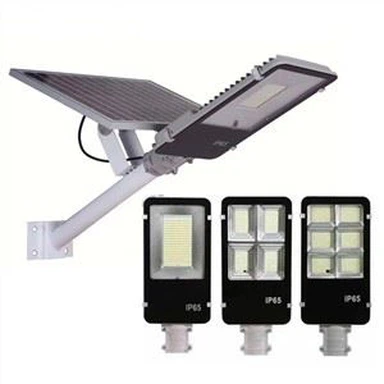

Do Streetlights Turn On One by One?
Sep 02, 2026
Do streetlights turn on one by one? The answer is not simply black or white-it depends on the type of streetlight. Solar streetlights and grid-powered streetlights follow completely different lighting logic. Each solar streetlight makes its own decision and starts or stops independently, while grid-powered streetlights are centrally scheduled and controlled in batches. The difference stems from their system structures and triggering mechanisms.
How Solar Streetlights Turn On?
Grid-powered streetlights are controlled through multiple parallel circuits, with each circuit switched on or off by an independent circuit breaker. Solar streetlights work differently: each light is an independent system that determines for itself when to turn on. The lighting signal for a solar streetlight comes from its solar panel. The most common control method is photo-controlled turn-on and time-controlled turn-off.

A solar panel is a photosensitive component. The stronger the ambient light, the higher the voltage generated by the solar panel, up to its peak voltage. Conversely, the weaker the light, the lower the voltage. This characteristic allows the solar panel to function as a natural light sensor and switch.
When the ambient illuminance falls below a certain level and the solar panel voltage drops to the preset turn-on voltage, the system switches on the streetlight. Before delivery, we configure the streetlight's operating hours and lighting mode according to the customer's requirements. The streetlight then turns off at the preset time.
Advantages of Photo-Controlled Turn-On for Solar Streetlights
1. The light turns on automatically when it gets dark, regardless of the season
Grid-powered streetlights may experience delays during seasonal changes or unusual weather because their turn-on times are not adjusted promptly to match actual lighting needs.
For example, when summer transitions into autumn, or on a rainy and overcast day when darkness falls earlier, grid-powered streetlights may not turn on until some time after sunset. This is because the relay is programmed to switch the lights on at a specific time-for example, 6:00 p.m. or 6:30 p.m. in summer. However, in autumn or on an overcast day, it may already be dark at 5:30 p.m. while the streetlights remain off.

Solar streetlights do not have this time gap. Regardless of the season or weather, once the ambient light falls below a certain level, the lights turn on automatically. In some cases, during a thunderstorm when heavy clouds make the sky very dark, solar streetlights may even turn on at noon. Once the storm passes and the sky becomes bright again, the solar streetlights do not wait until the preset time to turn off. Instead, they switch off automatically because the lighting control still takes priority in the turn-off logic.
2. Fully automatic operation with no seasonal adjustment required
Grid-powered streetlights require relay settings to be adjusted when the seasons change. Solar streetlights do not require this adjustment, which helps reduce maintenance costs.
Disadvantages of Photo-Controlled Turn-On for Solar Streetlights
1. Sensitivity to other light sources
The sun is not the only source of ambient light; artificial light from other sources can also affect the solar panel. If artificial light shines directly onto the solar panel, the solar streetlight may fail to turn on at night.
2. Obstructions may cause the light to turn on prematurely
If there is an obstruction above the solar panel, the light intensity at that location may be significantly lower than in surrounding areas. As a result, the solar streetlight may turn on earlier than other lights.

3. Inconsistent turn-on times
This is a common issue. Each solar streetlight may receive a different amount of light, and individual solar panels may also have slight voltage differences. Therefore, the lights may not turn on at exactly the same time.
However, when the lights receive similar levels of illumination, the time difference is usually not significant-normally just a few minutes, or around 10 to 20 minutes.
4. The lights usually turn on relatively late
To control energy consumption and reduce the overall cost of the lighting system, solar streetlights are generally configured to turn on relatively late. In addition, the adjustable voltage range is limited. As a result, most solar streetlights do not turn on until it is already quite dark.
Therefore, when selecting solar streetlights, property owners should consider whether they can accept these advantages and disadvantages and make a decision based on their specific circumstances.
How Grid-Powered Streetlights Turn On
System Overview
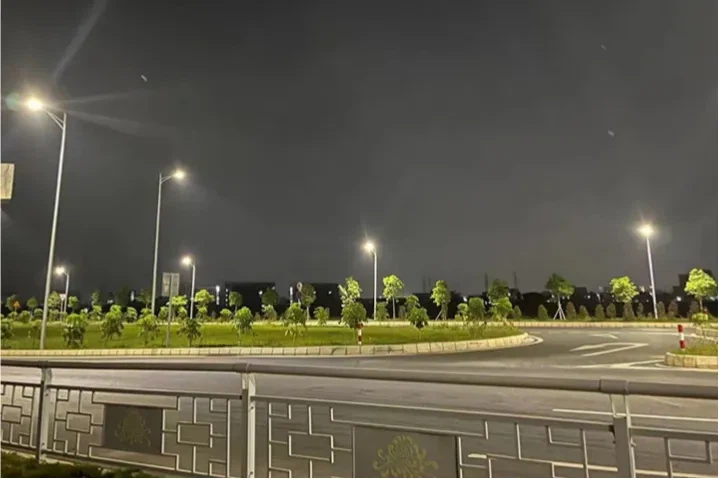
Grid-powered streetlights are grid-connected lighting systems that rely on the city's public power network. Their energy is supplied directly by a 220 V or 380 V public AC grid. The system mainly consists of a utility power supply circuit, a centralized control cabinet, LED driver power supplies, light sources, and poles. Unlike solar streetlights, they do not require solar panels or energy-storage batteries.
By drawing power directly from the public grid, grid-powered streetlights are switched on and off through control equipment. All the fixtures share the grid's energy supply, making this a typical centralized, grid-connected power supply system.
Electrical Characteristics
From an electrical perspective, grid-powered streetlights are high-voltage AC systems. LED fixtures must be equipped with dedicated driver power supplies, which convert high-voltage AC into low-voltage DC before the LEDs can operate properly.
Most grid-powered streetlights currently use an external integrated power supply solution. The driver transformer, circuit protection components, and smart control modules are integrated into a separate external enclosure. Compared with an internal power supply, this configuration provides better heat dissipation and reduces heat buildup inside the lamp housing, helping extend the service life of the light source.
It also allows maintenance personnel to replace the power supply without disassembling the lamp head. In addition, functions such as photocontrol and dimming can be integrated more flexibly to meet the control requirements of different road sections.
Centralized Time-Control System
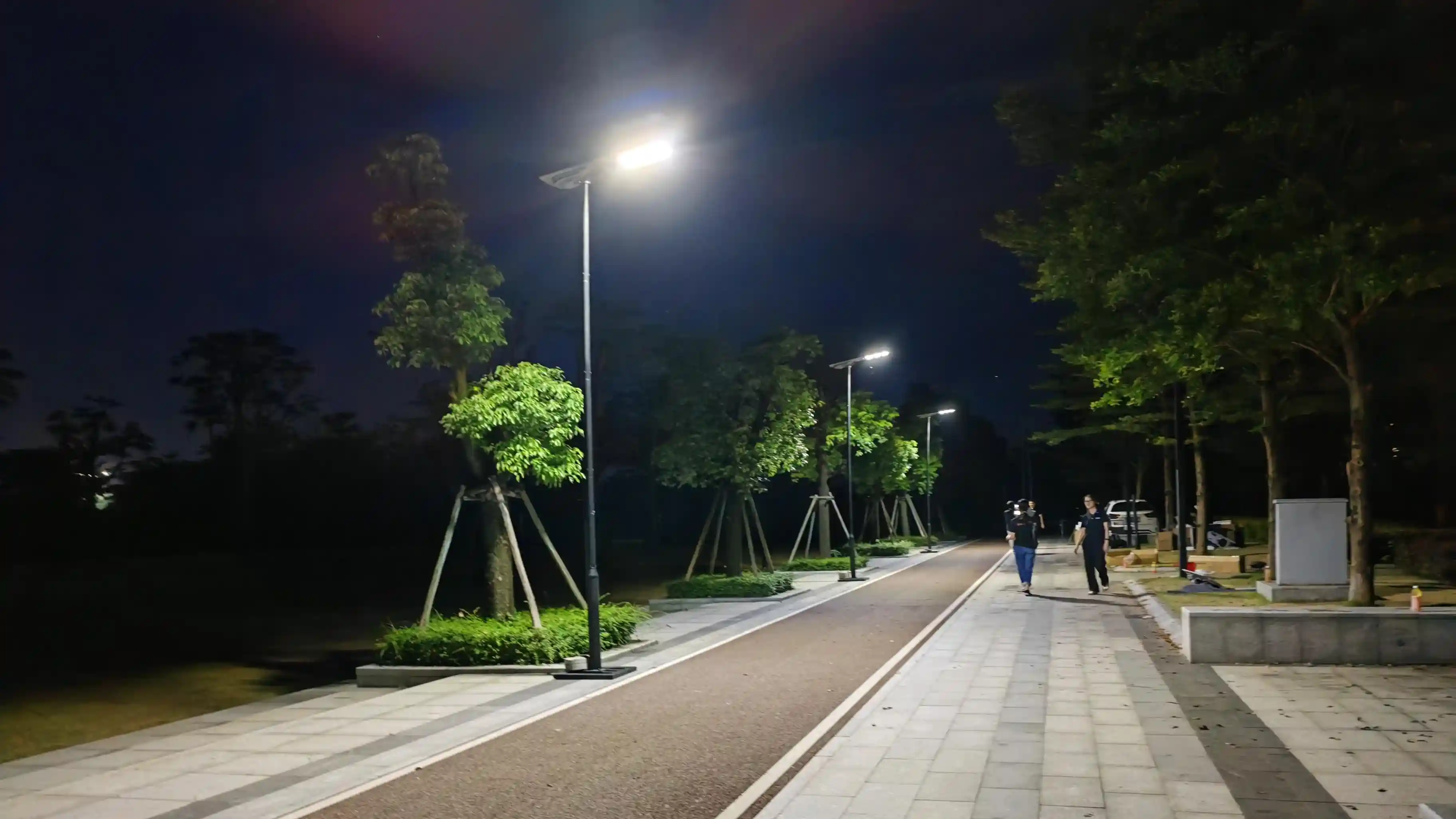
Grid-powered streetlights generally come standard with a centralized time-control system. Astronomical time switches, which are matched to the local sunrise and sunset times, are commonly used. Regional photocontrol can also be added, while individual lamp control is usually an optional feature.
Dimming and Energy Management
For grid-powered streetlights, dimming is primarily an optional method of saving energy and reducing consumption. The system can adjust brightness uniformly according to the time of day and traffic conditions, without concerns about battery runtime. Control is typically carried out at the circuit or regional level. Individual lamps can only be controlled separately after individual lamp controllers have been installed.
The core functions of a grid-powered streetlight control system focus on dispatch management and grid protection. Dispatch functions include scheduled switching, time-based and zoned control, and remote manual switching. Grid-protection functions include leakage protection, overload protection, short-circuit protection, and surge protection. The system can also support operational monitoring functions such as voltage and current measurement, proactive fault alerts, energy consumption statistics, and individual lamp status reporting.

Centralized Hierarchical Architecture
Its system architecture is based on centralized, hierarchical control, forming a multi-level management network consisting of:
City monitoring platform → Regional control cabinet → Individual lamp controller
The system relies on power cables and communication links such as power-line carrier communication, NB-IoT, and LoRa. This enables centralized management of streetlights across an entire area and the unified deployment of control strategies.
Conclusion
Streetlights do not all turn on in exactly the same way. Solar streetlights may turn on at different times because of variations in the lighting conditions around each individual lamp, whereas grid-powered streetlights generally turn on simultaneously across an entire circuit.