

Application of Intelligent Control in Tunnel Lighting
Jul 02, 2026
Highways, mountainous areas, and off-grid rural tunnels have long faced three major challenges: high electricity costs, expensive maintenance, and significant driving safety risks. Traditional full-power, time-based lighting cannot adapt to changes in ambient light or traffic flow, making it a key source of ongoing losses. Based on real measurement data from a 2,800-meter highway tunnel in China, this article provides procurement-focused insights into cost calculation and energy-saving benefits of Intelligent Control in Tunnel Lighting solutions.
What Are the Drawbacks of Traditional Tunnel Lighting?
1. High Energy Consumption Costs
Tunnel lighting operates continuously throughout the year. Traditional timer-based control does not adjust for day/night conditions or traffic volume, resulting in constant full-power operation.
According to measured data: a 2,800m tunnel equipped with 580 LED fixtures consumes approximately 1.865 million kWh annually, with annual electricity costs reaching 895,000 RMB. In regions with high electricity prices such as Europe, North America, and Australia, annual lighting costs for a single long tunnel can reach hundreds of thousands of euros, significantly straining maintenance budgets.

2. High Labor and Maintenance Costs
Tunnel environments are enclosed, and maintenance often requires lane closures, leading to long inspection cycles.
Issues such as voltage abnormalities, lumen depreciation, and heat dissipation failures cannot be detected in advance. Faulty lights may go unnoticed for weeks, creating dim sections that greatly increase the risk of traffic accidents. With high labor costs, routine monthly inspections represent a substantial hidden expense in tunnel lighting operations.
3. "Black Hole" and "White Hole" Effects at Tunnel Entrances
Natural light outside tunnels ranges from 10 to 100,000 lux. When vehicles enter a tunnel during the day, the sudden drop in brightness creates the "black hole effect." At night, exiting a brightly lit tunnel causes glare, known as the "white hole effect."
Conventional fixed-brightness lighting cannot adjust dynamically by zone, making it difficult to meet CIE88 international tunnel lighting safety standards, which can lead to project acceptance challenges.
4. Lack of Grid Power in Remote Areas
Many tunnels in mountainous regions across Southeast Asia, Africa, and Latin America lack access to grid electricity. The cost of installing cables and transformers is extremely high, making traditional grid-powered LED tunnel lighting difficult to implement and slowing down project progress.
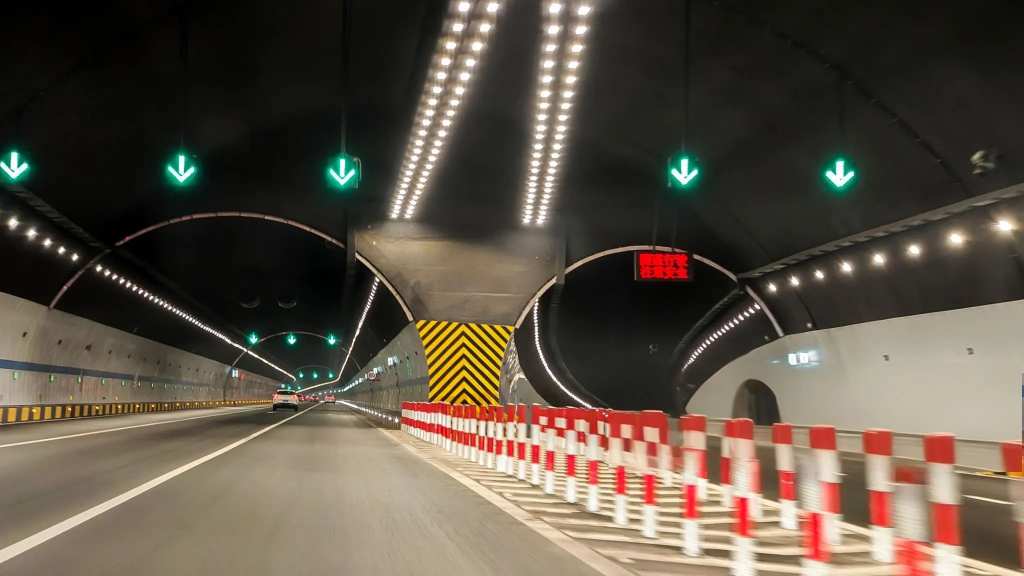
Four Core Features of Intelligent Control in Tunnel Lighting
An intelligent tunnel lighting system is built on LED tunnel luminaires and integrates ambient light sensors, traffic radar, smart gateways, and a cloud-based monitoring platform. Together, these components form a closed-loop adaptive control system. When combined with an energy storage or solar power system, the solution can also support off-grid operation. These four core technologies directly address the major limitations of traditional tunnel lighting.
1. Adaptive Dimming: On-Demand Lighting to Eliminate Energy Waste
The system deploys illuminance sensors at tunnel entrances and installs traffic detectors in different tunnel zones. Combined with PWM continuous dimming technology (0–100% with 1% precision), it dynamically adjusts brightness across entrance, transition, and interior sections.
- Strong daylight conditions: Increase illumination at the entrance zone to eliminate the "black hole effect"
- Rainy or nighttime conditions: Reduce overall baseline brightness
- Low-traffic periods (late night/early morning): Significantly reduce power consumption
- Foggy or severe weather: Automatically increase brightness to ensure visibility
Built-in time-based preset modes eliminate the need for frequent manual adjustments, enabling the system to adapt to regional daylight patterns and traffic flow automatically.

2. Fault Prediction: From Reactive Maintenance to Predictive Maintenance
Each LED tunnel luminaire is equipped with independent monitoring sensors that continuously collect voltage, current, temperature, and luminous flux data. Two advanced analytical models are embedded in the system:
Lumen Degradation Model: Lt = L0 × e^(-αt) is used to quantify real-time light depreciation and predict replacement cycles in advance.
Thermal Rise Analysis Model: Continuously monitors abnormal heat dissipation to prevent LED failure caused by overheating.
The cloud platform uses a GIS-based map system to mark faulty luminaires with pinpoint accuracy down to specific circuits and locations. This allows maintenance teams to avoid full-line inspections, reducing fault response time from 24 hours to just minutes and significantly minimizing lane closures.
3. Remote Monitoring: Centralized Management Across Multiple Projects
The communication architecture is structured into three layers: field devices, transmission gateways, and cloud-based monitoring platforms, enabling unified control of multiple tunnel projects across different regions.
- Communication protocol: Modbus/TCP with AES encrypted transmission
- Redundant communication links ensure stable performance in complex tunnel electromagnetic environments
- Web and mobile app access allows remote configuration, energy report export, and system monitoring
- Supports automatic, scheduled, and manual control modes
- Emergency mode enables instant switch to full brightness during incidents
This architecture allows centralized management of multiple tunnel lighting systems from a single control center.

4. Energy Optimization: Data-Driven Power Efficiency
The system integrates smart energy meters to monitor real-time power consumption for each circuit. Using genetic algorithms and particle swarm optimization models, it automatically determines the optimal power configuration for maximum efficiency.
It also includes a carbon emission calculation module, making it suitable for EU and global low-carbon infrastructure projects and green certification applications. Monthly and annual energy consumption reports can be exported as structured charts, which can be directly used for engineering bids, operational audits, and project documentation.
Measured Energy-Saving Performance of Intelligent Control in Tunnel Lighting
Based on operational data from a 2,800-meter two-way, six-lane highway tunnel equipped with 580 LED luminaires, the following comparison highlights the economic benefits of an intelligent lighting control system. These results can be directly used as a benchmark for similar tunnel projects.
Performance Comparison Table
|
Evaluation Metric |
Traditional Timer Control |
Intelligent LED Control System |
Improvement |
|
Annual Energy Consumption |
1.865 million kWh |
1.082 million kWh |
42% energy savings |
|
Annual Electricity Cost |
895,000 RMB |
519,000 RMB |
42% reduction (≈376,000 RMB saved annually) |
|
Peak Operating Power |
165.0 kW |
98.5 kW |
40.3% reduction |
|
Low-Traffic Power Consumption |
165.0 kW |
58.2 kW |
64.7% reduction |
|
Total Retrofit Investment |
1.05 million RMB |
- |
Payback period: 2.8 years |
Key Benefit Insights
- Maximum energy savings occur during low-traffic periods, where power consumption drops by more than 64%, especially during nighttime and holidays when traffic volume is minimal.
- The system achieves a full investment payback within 2.8 years, while the typical service life of tunnel lighting systems ranges from 5 to 8 years, meaning subsequent years generate pure operational savings.
- Intelligent fault prediction significantly reduces hidden costs related to lamp replacement, manual inspection, and traffic lane closures.
Off-Grid Solar Tunnel Lighting Solution
For remote tunnels without access to grid power, we also provide an integrated solar-powered LED tunnel lighting system, which includes:
- Photovoltaic panels
- Lithium battery energy storage system
- Same intelligent dimming and control platform
This solution operates completely off-grid, enabling zero electricity cost operation and is ideal for tunnel projects in:
- Africa
- Southeast Asia
- Mountainous regions
- Mining access roads
The system supports customizable energy storage capacity, offering 3–7 days of autonomy during cloudy or rainy conditions, ensuring stable and uninterrupted lighting performance even in extreme environments.
Project Adaptability Advantages
1. Full Range of International Certifications
Yahua Lighting's grid-powered smart LED tunnel lights and solar tunnel lighting systems are certified with CE, RoHS, EMC, DLC, and UN38.3 (battery certification). These certifications ensure compliance with mandatory infrastructure standards in the EU, United States, Australia, and Southeast Asia, and third-party test reports can be directly used for project bidding and procurement approval.
2. Adaptability to Harsh Environments
The luminaires feature an IP66-rated waterproof and dustproof structure with a corrosion-resistant aluminum housing, enabling stable operation in extreme conditions:
- Operating temperature: -30°C to +60°C
- Coastal high-salt fog environments
- High-humidity mountainous regions
- Desert high-temperature tunnel conditions
This ensures long-term reliability across diverse and challenging geographies.

3. Complete ODM/OEM Customization Services
We provide full customization capabilities for global project requirements:
- Adjustable lamp power, color temperature, and light distribution curves
- Multi-language smart control platform (English, Spanish, French, etc.)
- Solar panel wattage and battery capacity customized based on local solar conditions
- Private labeling (logo, packaging, manuals, and branding customization)
- Full-container export support
To simplify procurement, we provide a complete integrated tunnel lighting solution, eliminating the need to source lamps, controllers, sensors, and monitoring platforms separately. We also supply installation drawings and remote commissioning guidance to reduce supply chain coordination costs for contractors.
Application Scenarios of Intelligent Control in Tunnel Lighting
This intelligent tunnel lighting system is suitable for a wide range of infrastructure projects, including:
- Cross-border highways and long tunnel expansion projects
- Highway renovation and legacy lighting upgrades
- Mountainous, mining, and rural off-grid tunnel projects (solar LED tunnel lighting systems recommended)
- Urban underpasses and underground vehicle passages
- Lighting distributors and engineering contractors for bulk supply
- Government-led energy-saving and green infrastructure bidding projects

Conclusion
Intelligent LED tunnel lighting systems equipped with adaptive dimming, fault self-diagnosis, and cloud-based remote management have demonstrated.For off-grid or remote tunnel projects, solar-powered LED tunnel lighting solutions completely eliminate the need for grid electricity and cable infrastructure, significantly reducing upfront construction costs.
Both solutions can be fully customized based on project scale, local electricity pricing, and solar conditions, and are delivered with complete certification and bidding documentation to support contractors and municipal buyers in winning projects while reducing long-term operational costs.
For detailed resources such as energy-saving calculation sheets, engineering case studies (PDF), and product technical datasheets, please contact:sales@sxyhzm.com. Simply provide tunnel length, number of lanes, and local electricity/solar conditions, and our engineering team will prepare a free customized lighting design and ROI analysis. We support sample testing, small trial orders, and full-container shipments. Long-term cooperation with EPC contractors and lighting distributors is welcome.


